
BLOG
Why Some Bearings Last Longer: Inside the Heat Treatment Process
Two bearings can arrive in the same carton, carry the same part number, and look identical on a bench. Put them into service, though, and one runs quietly for years while the other starts to shed metal, heat up, or develop vibration long before its calculated life is up. When that happens, it’s tempting to blame lubrication or mounting. Sometimes that’s fair. But just as often, the real difference is baked into the steel long before the bearing ever sees your machine.
Heat treatment is the part of bearing making that feels least “visible” and most consequential. It decides what phases exist in the steel, how residual stresses are distributed, how stable the geometry remains over time, and how the raceways respond to rolling contact fatigue.
What “heat treatment” actually changes in a bearing
The phrase heat treatment process covers a family of controlled heating and cooling steps that reshape the steel’s microstructure. For bearing rings and rolling elements, the objective is not “maximum hardness at all costs,” but a tuned combination of:
High surface hardness to resist wear and micro-pitting at the raceway,
Enough toughness to tolerate impacts, misalignment, and handling damage,
Dimensional stability so preload and clearance don’t drift in service, and
Low defect sensitivity so inclusions or micro-notches don’t turn into early cracks.
When people talk about heat treatment bearings durability, they’re really talking about how well these tradeoffs were managed for the bearing’s duty cycle, lubricant regime, and contamination reality (not the idealized version).
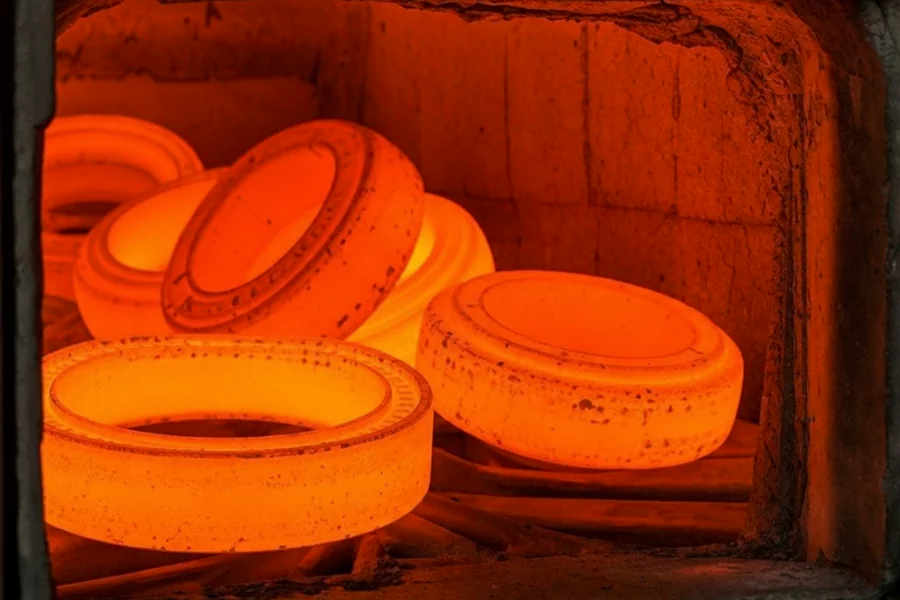
The core steps: austenitize, quench, temper (and why each can go wrong)
Most conventional bearing steels are austenitized (heated above a critical temperature so carbon and alloying elements are in solution), quenched (cooled quickly enough to form martensite), and tempered (reheated to relieve stress and reduce brittleness).
That sounds linear, but the “knobs” are numerous: soak time, furnace atmosphere, quench severity, agitation, part geometry, and the delay between steps. Small deviations don’t always show up in a hardness check. They show up later as noise, spalling, or unstable clearance.
Austenitizing: sets the stage. Overheating or poor atmosphere control can encourage grain growth or surface decarburization—both classic precursors to weak raceways.
Quenching: creates hardness, but also creates stress. An overly aggressive quench can seed microcracks; an uneven quench can create “soft bands” that become preferential fatigue sites.
Tempering: is where many “long life” bearings separate themselves. Proper tempering reduces internal stress and stabilizes the structure so the bearing doesn’t slowly change size under operating heat.
Through hardening vs carburizing: two philosophies of risk
It’s common to frame bearing hardening as a binary choice, but it’s more helpful to treat it as two different risk profiles.
Through hardening
With through hardening, the ring or rolling element is hardened essentially all the way through. This tends to suit clean, well-lubricated applications where the dominant damage mode is subsurface rolling contact fatigue. A well-executed through-hardened bearing is straightforward to predict and consistent to manufacture at scale.
Case hardening (carburizing)
Carburizing creates a hard, wear-resistant surface while leaving a tougher core. That tougher core is not a marketing detail—it matters when the real world includes shock loads, edge loading, transient skidding, or occasional contamination. Under those conditions, a brittle core can be unforgiving.
In practice, “case carburizing vs through hardening bearings” is a choice about where you want the structure to yield, how you want cracks to behave, and how you want the bearing to react when the application is imperfect (because it will be, at least sometimes).
Microstructure is not trivia: martensite, bainite, and retained austenite
The hardest part of explaining bearing heat treatment is that the end goal is microscopic, while the consequences are macroscopic. A raceway doesn’t fail because it was “a bit off.” It fails because the steel’s phases and stresses steered cracks toward the surface.
Martensite (common, effective, but needs discipline)
The classic route is martensite plus tempering. Done well, it delivers high hardness and good fatigue performance. Done carelessly, it can carry too much residual stress, leaving the bearing vulnerable to early spall initiation, especially under variable load or poor lubrication.
Bainite (useful when toughness and crack resistance lead)
Some designs use bainitic structures (often via austempering) to prioritize toughness and crack resistance. It can be a practical answer in applications where contamination and boundary lubrication are routine rather than exceptional.
Retained austenite: the “stability tax” you must manage
Quenching rarely converts all austenite to martensite. The remainder—retained austenite—can be beneficial in small, controlled amounts, but problematic when excessive. Its transformation later (from operating heat, time, or stress) can change volume and therefore change geometry. That’s why the retained austenite impact on bearing performance shows up as a subtle shift in noise, preload, or clearance before it shows up as obvious damage.
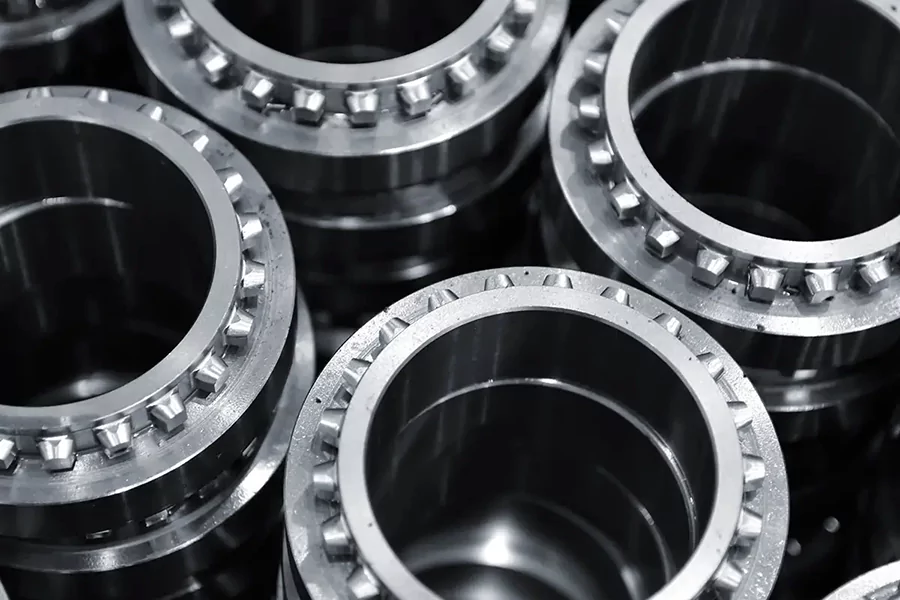
Process add-ons that often decide field performance
Not every bearing needs every refinement, but high-end bearings typically use one or more of the following to reduce scatter and improve stability:
Sub-zero (cryogenic) treatment: used to reduce retained austenite and improve dimensional stability, particularly in precision or high-speed bearings.
Controlled atmospheres: to prevent decarburization and oxidation that can quietly sabotage surface integrity.
Secondary tempering cycles: especially for bearings expected to see elevated operating temperatures for long periods.
Localized hardening: in some cases, induction hardening versus salt bath furnace choices reflect whether you need localized response or maximal temperature uniformity across complex geometry.
Carbonitriding: when the goal is improved wear resistance through carbonitriding plus better scuff resistance at the surface.
A practical way to connect heat treatment to “bearing life” (without oversimplifying)
Most engineers encounter bearing life through L10 calculations and load ratings. Those tools are useful, but they treat the material as a set of assumed properties. In the field, what matters is how often the bearing experiences damaging stress states: edge loading, micro-slip, contamination dents, lubricant starvation, and thermal excursions.
Heat treatment influences how the steel responds to those events. A surface that is hard but poorly supported (or overly stressed) may resist wear yet crack early. A core that is tough but paired with a weak case depth may deform under load, leading to surface distress. “Better heat treatment” is therefore not a single number—it is lower variability plus a structure that matches the application’s failure modes.
Actionable guidance when you’re specifying or sourcing bearings
Ask what the bearing was optimized for: clean fatigue life, shock resistance, high temperature stability, or contamination tolerance. Different heat treatment choices align with different priorities.
Match the method to the reality: if your environment is shocky or alignment is imperfect, consider case-hardened options rather than defaulting to through-hardened designs.
Don’t ignore thermal stability: if your bearing runs hot for long periods, insist on stabilization practices appropriate to the operating range.
Watch the language around durability: if you’re comparing suppliers, request consistency data (not just nominal hardness). Scatter is often the hidden enemy.
Closing thought
When a bearing fails early, the frustration is rarely just technical—it’s downtime, disrupted schedules, and the pressure of explaining “why this happened again.” Heat treatment won’t compensate for every installation or lubrication issue, but it can widen the margin between a bearing that tolerates real-world imperfections and one that doesn’t. Understanding the thermal history behind the steel is one of the most reliable ways to understand why some bearings last longer—and to specify components that behave that way in your plant, not just in a catalog.
Optimize Your Supply Chain
Work with a Trusted Bearing Manufacturer Today!
Leave us a message. We will contact within 12 hours.