
BLOG
A Buyer’s Guide to Bearing Standards: ISO, DIN, and JIS
This guide is written for engineers, purchasing managers, and workshop owners who buy rolling bearings and need to make technically sound, procurement-friendly decisions. It explains the practical meaning of the major bearing standards (ISO, DIN, JIS), how tolerance (precision) classes map to application needs, and gives a concise buyer checklist to reduce risk and improve interchangeability.
Why standards matter
Bearing standards define uniform boundary dimensions, tolerances, running accuracy and clearance definitions so bearings from different manufacturers can be specified, ordered and installed with predictable fit and performance. Standards reduce rework, lower inventory complexity and are essential when performance or interchangeability matters.
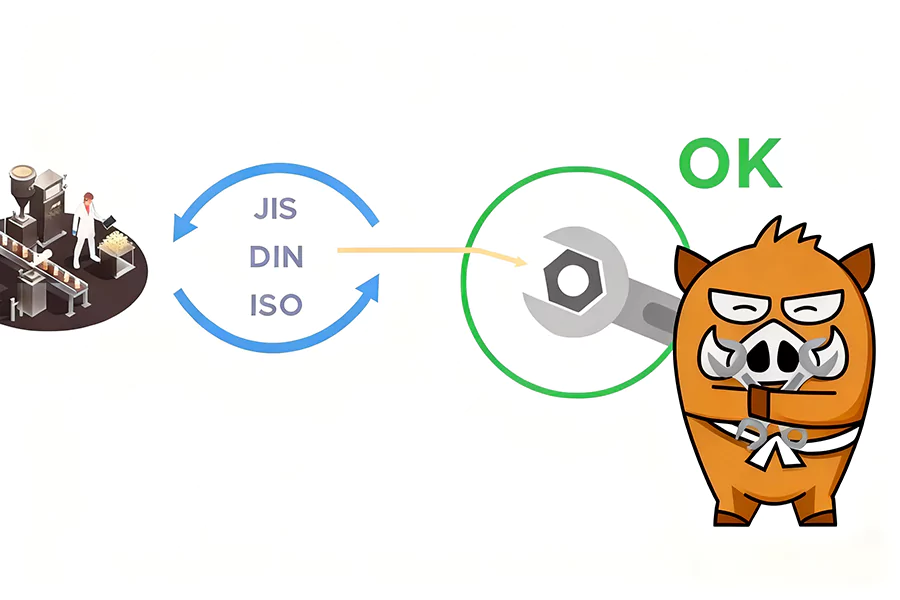
Key bearing standards — what each covers
ISO (International)
ISO is the global baseline for metric rolling bearings. Important ISO documents include the boundary-dimension standard for radial bearings (ISO 15) and the tolerances and running-accuracy specifications (ISO 492). ISO references are widely used when buyers need vendor-agnostic, internationally accepted bearing specifications.
DIN (Germany)
DIN standards for rolling bearings historically align with ISO metric series and tolerance systems. DIN documents are commonly found in European drawings and legacy specifications and typically correspond directly to ISO-defined dimensions and quality levels.
JIS (Japan)
JIS standards describe bearing tolerances and dimensional rules that broadly correspond with ISO metric rules. When sourcing from Japanese manufacturers, JIS references are common, but the bearing series and tolerance classes usually map directly to ISO equivalents.
Tolerance classes (what the numbers mean in practice)
Bearing standards generally define several precision or tolerance classes. For metric bearings, these typically include Class 0 (normal), 6X, 6, 5, 4, and 2. Lower class numbers indicate higher precision.
Class 0 (Normal) — Suitable for general machinery, agricultural equipment, and standard-duty applications.
Class 6 / 6X — Higher running accuracy than normal class, often selected where vibration and noise control are important.
Class 5, 4, 2 — High-precision classes used for demanding applications such as machine-tool spindles, high-speed equipment, and precision instruments.
Selecting the appropriate tolerance class is a balance between performance requirements and cost. Over-specifying precision can significantly increase bearing cost without delivering practical benefits.
Interchangeability — when a bearing from Supplier A fits Supplier B’s design
Because ISO, DIN, and JIS standards define consistent metric boundary dimensions and tolerances, bearings with the same series designation are generally interchangeable across manufacturers. For example, a 6205 bearing produced under JIS standards will usually fit the same application as a DIN or ISO equivalent, provided the tolerance class and internal clearance are the same.
However, buyers should still verify shaft and housing fits, internal clearance, chamfer dimensions, and any special materials or coatings before substitution.
Practical buyer considerations
Clearly specify the standard and tolerance class
Always state the applicable bearing standard and tolerance class on purchase orders and RFQs to avoid ambiguity.Match tolerance class to application needs
Use Class 0 or Class 6 for general applications, and higher precision classes for high-speed or low-vibration environments.Confirm internal clearance requirements
Radial internal clearance (such as C2, C0, or C3) has a direct impact on bearing life and operating temperature.Verify measurement units and series
Metric sizes are standard for ISO, DIN, and JIS bearings. Ensure drawings and specifications are consistent, especially when converting from inch-based systems.Request technical documentation
Dimensional drawings, tolerance tables, and inspection reports help confirm compliance with stated standards.Be aware of counterfeit risks
Bearings that do not meet declared standards can fail dimensional or performance tolerances. Working with verified manufacturers and requesting traceable documentation reduces this risk.
How to verify vendor claims
Buyers can reduce risk by asking suppliers to clearly identify the applied bearing standard and tolerance class, and by requesting dimensional inspection data when precision is critical. For high-value or safety-related applications, sample inspection and independent measurement can further validate compliance.
About GELWEKR
GELWEKR supplies bearings and power transmission components for industrial and agricultural applications, with product designs aligned to widely recognized bearing standards such as ISO, DIN, and JIS. By offering consistent dimensional control, clearly defined tolerance classes, and technical documentation support, GELWEKR helps buyers source bearings that integrate smoothly into existing equipment while maintaining reliable performance.
Optimize Your Supply Chain
Work with a Trusted Bearing Manufacturer Today!
Leave us a message. We will contact within 12 hours.